
Cagrilintide Research Guide (2026): Appetite Regulation & Metabolic Research

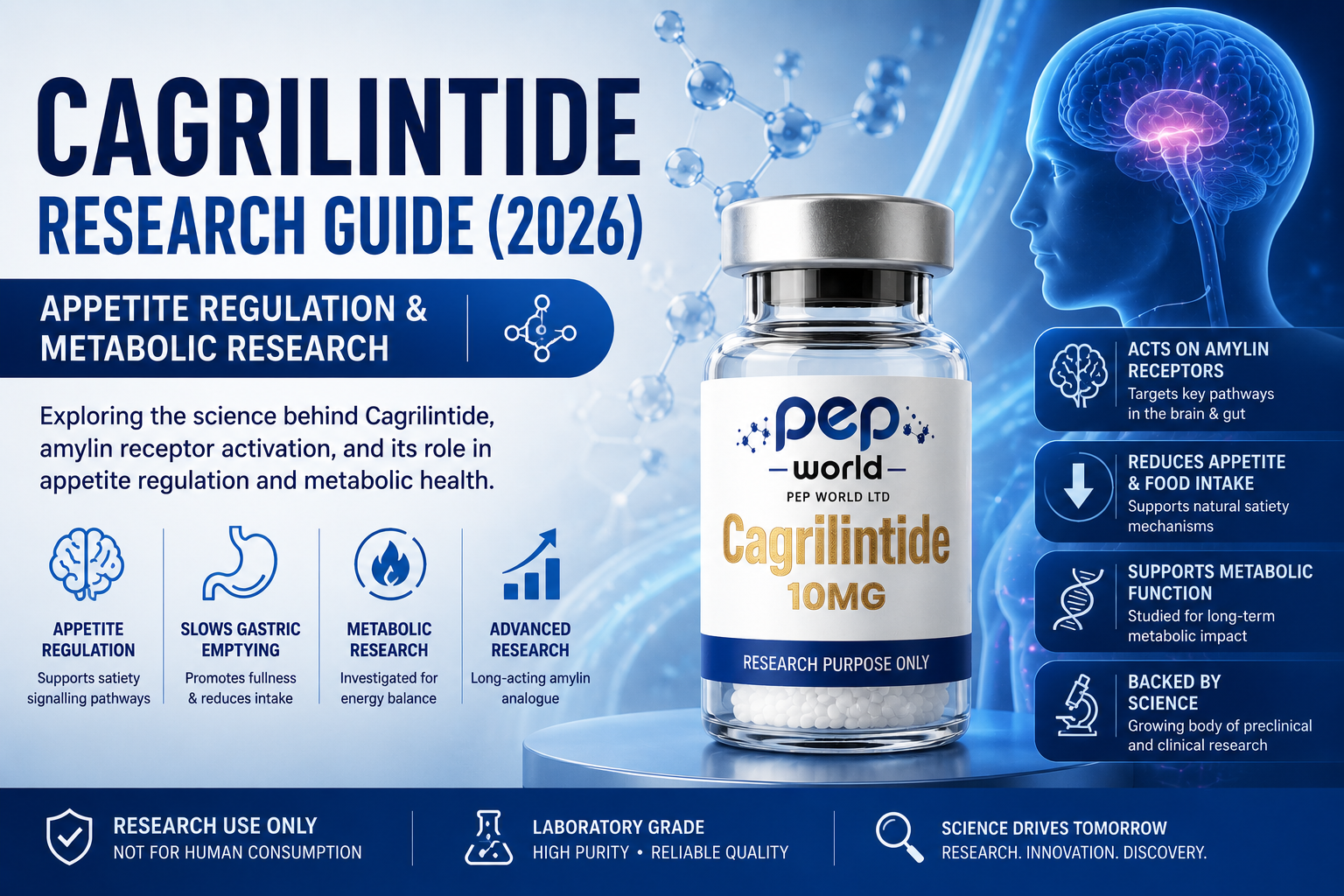
Cagrilintide Research Guide (2026): Appetite Regulation & Metabolic Research
Disclaimer: This article is provided for educational and scientific information only. Cagrilintide is intended for research purposes only and is not approved for human consumption. PepWorld supplies research peptides exclusively for laboratory research.
Introduction
Peptide research continues to evolve rapidly, and one molecule attracting considerable scientific interest is Cagrilintide. Researchers are investigating its effects on appetite regulation, metabolic pathways, gastric emptying, and long-term energy balance.
Unlike traditional GLP-1 receptor agonists, Cagrilintide belongs to a different peptide family. It is a long-acting amylin analogue, designed to mimic one of the body’s naturally occurring metabolic hormones.
Throughout 2026, laboratories worldwide continue exploring how Cagrilintide may influence food intake and metabolic regulation, particularly when investigated alongside other metabolic research peptides.
This guide explains the current science, research mechanisms, laboratory findings, and future directions surrounding Cagrilintide.
What is Cagrilintide?
Cagrilintide is a synthetic long-acting analogue of amylin, a hormone naturally secreted alongside insulin by pancreatic beta cells.
Amylin plays several physiological roles, including:
- Appetite signalling
- Slowing gastric emptying
- Regulating glucagon secretion
- Influencing satiety pathways
- Supporting metabolic homeostasis
Because natural amylin has a short half-life, researchers developed Cagrilintide to provide prolonged biological activity suitable for laboratory investigations.
How Does Cagrilintide Work?
Current research suggests that Cagrilintide activates amylin receptors located within multiple regions involved in energy regulation.
Its primary mechanisms include:
Appetite Regulation
Laboratory studies indicate activation of satiety signalling pathways may reduce food-seeking behaviour.
Gastric Emptying
Researchers continue investigating how delayed gastric emptying influences nutrient absorption and appetite signalling.
Brain Signalling
Studies suggest Cagrilintide affects appetite centres within the central nervous system, helping researchers better understand hunger regulation.
Energy Balance
Ongoing research explores how long-term amylin receptor activation may contribute to overall metabolic regulation.
Why Researchers Are Interested in Cagrilintide
Interest in Cagrilintide has grown because it targets different biological pathways than GLP-1 peptides.
Scientists are studying:
- Appetite signalling
- Metabolic regulation
- Satiety mechanisms
- Hormonal interactions
- Combination peptide research
- Long-term metabolic adaptation
Its unique mechanism makes it valuable for expanding knowledge of metabolic physiology.
Cagrilintide vs GLP-1 Research
Although often discussed alongside GLP-1 peptides, Cagrilintide acts through a distinct pathway.
| Feature | Cagrilintide | GLP-1 Research Peptides |
|---|---|---|
| Primary Target | Amylin Receptors | GLP-1 Receptors |
| Main Focus | Satiety signalling | Insulin & appetite regulation |
| Gastric Emptying | Yes | Yes |
| Appetite Research | Strong | Strong |
| Hormone Type | Amylin analogue | GLP-1 analogue |
Because the mechanisms differ, researchers are exploring how these pathways may complement one another in metabolic studies.
Current Areas of Cagrilintide Research
Scientists continue investigating several important applications.
Appetite Regulation
Research examines how amylin receptor activation influences hunger signalling and feeding behaviour.
Obesity Research
Laboratories are studying metabolic adaptations associated with prolonged appetite suppression.
Energy Homeostasis
Scientists investigate how Cagrilintide contributes to maintaining energy balance under different nutritional conditions.
Combination Peptide Research
Researchers are increasingly exploring Cagrilintide alongside GLP-1 receptor agonists to understand potential complementary mechanisms.
Endocrine Function
Studies also evaluate how amylin signalling interacts with other metabolic hormones involved in glucose and appetite regulation.
Advantages for Research
Several characteristics make Cagrilintide particularly useful in laboratory settings.
Long Duration
Its extended activity enables researchers to study prolonged receptor activation.
Novel Mechanism
Unlike GLP-1 peptides, Cagrilintide focuses primarily on amylin receptor pathways.
Stable Experimental Design
Its pharmacological profile supports controlled laboratory investigations over extended periods.
Growing Scientific Interest
An increasing number of published studies continue expanding knowledge surrounding amylin biology.
Laboratory Handling Considerations
Researchers should always follow institutional laboratory protocols.
General recommendations include:
- Store according to manufacturer guidance.
- Protect from excessive heat and light.
- Use sterile laboratory equipment.
- Avoid repeated freeze-thaw cycles.
- Record storage and handling conditions for reproducibility.
Frequently Asked Questions
No. It is an amylin analogue that acts primarily through amylin receptors rather than GLP-1 receptors.
Researchers study it because of its role in appetite regulation, satiety signalling, and metabolic physiology.
Yes. Ongoing laboratory research explores Cagrilintide in combination with other metabolic research peptides to better understand complementary biological pathways.
Its long-acting amylin receptor activity distinguishes it from many other peptides currently used in metabolic research.
No. PepWorld supplies Cagrilintide strictly for laboratory research purposes only. It is not intended for human consumption.
Conclusion
Cagrilintide represents one of the most promising research peptides for studying appetite regulation and metabolic signalling. Its long-acting amylin receptor activity provides scientists with valuable opportunities to investigate satiety pathways, hormonal interactions, and energy balance.
Although research is still evolving, the growing body of scientific literature continues to improve our understanding of how amylin-based peptides influence metabolic processes. For laboratories focused on obesity, endocrinology, or metabolic biology, Cagrilintide remains an important molecule for ongoing investigation.
Research Use Only
PepWorld supplies Cagrilintide exclusively for research purposes. All products are intended for laboratory and scientific research only and are not for human consumption.



Very well presented. Every quote was awesome and thanks for sharing the content. Keep sharing and keep motivating others.