How to Read a Peptide Certificate of Analysis (COA)

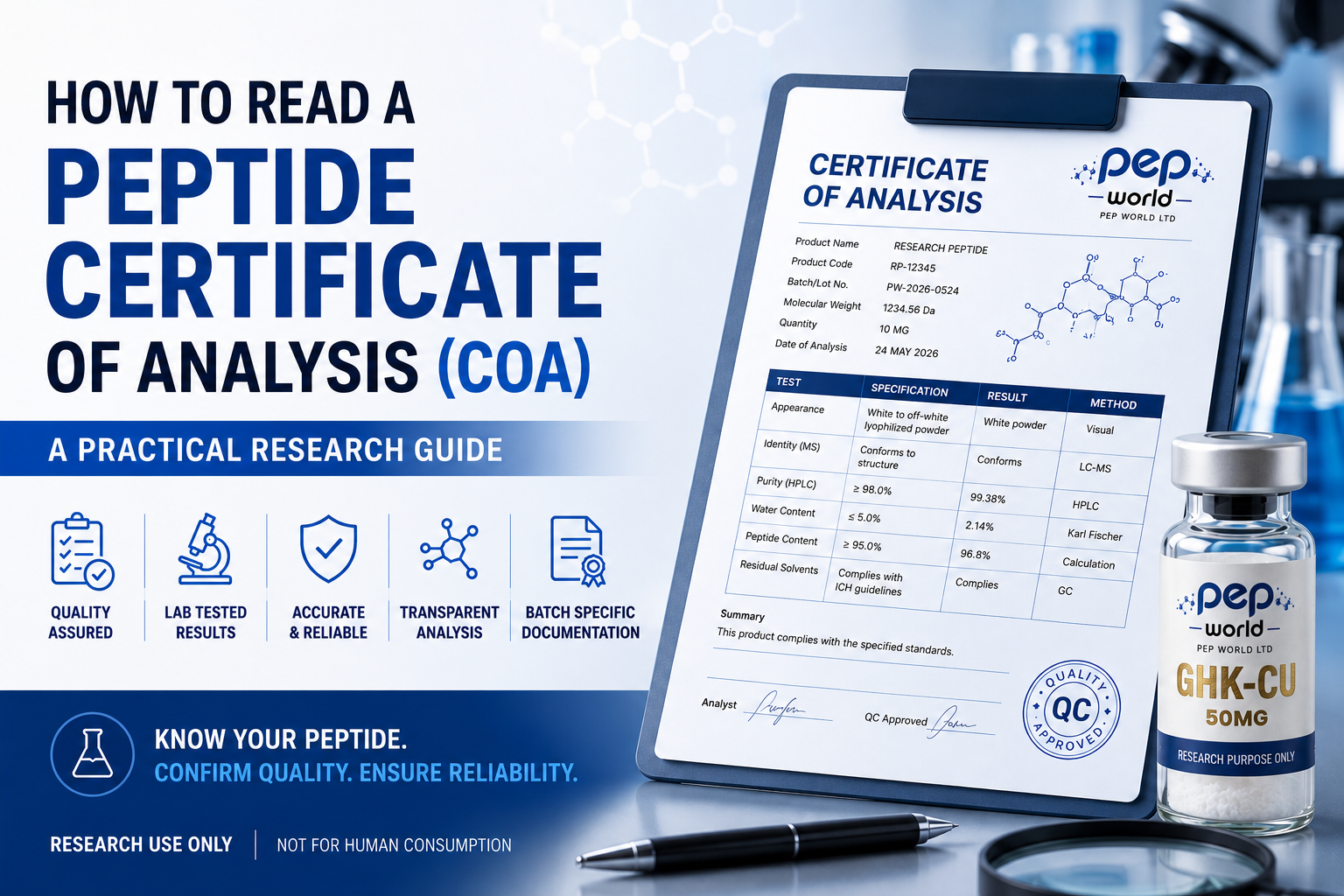
How to Read a Peptide Certificate of Analysis (COA)
Buying a research peptide is only part of the process. If you’re working with peptides in a laboratory, you also need to know exactly what you’re receiving.That’s where a Certificate of Analysis (COA) comes in. A COA is a quality document that reports the testing performed on a particular batch of material. It can tell researchers important information about identity, purity, quantity, and other quality characteristics. But there’s a problem: COAs can look confusing if you don’t regularly work with analytical data. Terms such as HPLC, MS, purity, molecular weight, batch number, and assay can make a simple document seem much more complicated than it actually is.
This guide breaks down the main sections of a peptide COA and explains what researchers should look for when evaluating a research peptide.
Important: This article is for educational and laboratory research purposes only. Research peptides discussed by PepWorld are not intended for human consumption, self-administration, diagnosis, or treatment of any medical condition.
What Is a Peptide COA?
A Certificate of Analysis, commonly called a COA, is a document associated with a specific product batch.
It generally records the results of quality-control testing performed on that batch and may include information such as:
- Product name
- Batch or lot number
- Molecular formula
- Molecular weight
- Appearance
- Peptide purity
- Identification testing
- Analytical methods
- Test results
- Specifications
- Date of analysis
- Storage information
The exact format varies between suppliers and laboratories.
The important point is this:
A COA should relate to the actual batch you’re purchasing or researching—not simply be a generic document for the product name.
Why Is a COA Important for Research Peptides?
Peptide research depends heavily on consistency. If researchers don’t know what material they’re working with, interpreting experimental results becomes much more difficult. A COA provides analytical information that can help researchers evaluate whether a particular batch meets its stated specifications.
For example, two vials may carry the same peptide name but come from different production batches. Their analytical results may therefore need to be documented separately.
A batch-specific COA gives researchers a much clearer quality record.
1. Start With the Product Name
The first thing to check is surprisingly simple:
Does the COA actually identify the peptide you’re expecting?
Look for:
- Peptide name
- Product code
- Catalog number
- Form of the material
- Quantity or strength, where applicable
If you’re researching a specific peptide, the name on the COA should correspond with the material supplied.
Don’t skip this step just because the document has an official-looking layout.
2. Check the Batch or Lot Number
The batch number is one of the most important pieces of information on a COA.
It connects the document to a particular production batch.
For example:
Product: Research Peptide X
Batch: PW-2026-014
The batch number on the vial, packaging, documentation, and COA should correspond where applicable.
Why does this matter?
A supplier may have produced the same peptide multiple times.
The analytical results from one batch shouldn’t automatically be assumed to represent another.
Always look for batch-specific documentation whenever possible.
3. Understand Peptide Purity
One of the most commonly discussed numbers on a peptide COA is purity.
You may see something like:
Purity: ≥98%
or:
HPLC Purity: 99.1%
This generally refers to the proportion of the analyzed material represented by the target peptide under the specified analytical method.
However, there’s an important detail that is often overlooked:
Purity is not the same thing as identity.
A high purity result doesn’t, by itself, prove that the material is the correct peptide.
That’s why researchers should look at identity testing alongside purity data.
4. What Is HPLC?
HPLC stands for High-Performance Liquid Chromatography. It is a widely used analytical technique for separating components within a sample.
In peptide analysis, HPLC can help researchers evaluate the chromatographic profile of a sample and estimate the relative amount of the target peptide compared with detected impurities under the specified conditions.
A COA may report:
HPLC Purity: 98.7%
This is useful information, but the number should always be considered together with the method and testing conditions. A percentage without analytical context doesn’t tell you everything about a sample.
5. What Is Mass Spectrometry (MS)?
Mass spectrometry, often abbreviated MS, is commonly used for molecular identification. It measures the mass-to-charge characteristics of ions and can provide information that helps confirm whether the observed molecular mass is consistent with the expected compound.
A COA might list:
Expected Molecular Weight: 1,234.5 Da
Observed: 1,234.4 Da
The exact interpretation depends on the peptide, analytical method, instrumentation, and reporting conventions. For research purposes, MS data can provide an important piece of evidence supporting peptide identity.
6. Purity vs Identity: Don't Confuse Them
This is one of the biggest mistakes people make when reading COAs.
Purity asks:
How much of the analyzed sample appears to correspond to the target material under the stated method?
Identity asks:
Does the material’s analytical profile support that it is the expected compound?
They’re related, but they’re not interchangeable. A useful COA should provide enough information for researchers to understand both the quality and identity testing performed.
7. Look at the Molecular Weight
Peptides have specific molecular weights based on their molecular composition.
A COA may list:
Molecular Weight: XXXX.XX g/mol
or:
Molecular Weight: XXXX.XX Da
The expected value can be compared with analytical results where mass spectrometry or another suitable identification method has been used.
Small differences can occur depending on factors such as:
- Peptide modifications
- Salt forms
- Counterions
- Water content
- Analytical technique
- Reporting conventions
So don’t assume that every number must match to the last decimal place without understanding the method.
8. Check the Appearance
COAs sometimes include a basic physical description, such as:
- White powder
- Off-white powder
- Clear solution
- Lyophilized material
Appearance is useful as a basic quality-control observation, but it cannot confirm peptide identity or purity by itself. A material looking correct doesn’t prove that it is analytically correct. Think of appearance as one small piece of the overall quality picture.
9. Check the Quantity and Form
Depending on the product, the documentation may specify information such as:
- Net peptide quantity
- Concentration
- Lyophilized powder
- Solution
- Salt form
- Counterion
- Formulation details
This is particularly important when comparing different research materials.
For example, 10 mg of lyophilized peptide isn’t necessarily equivalent from an analytical perspective to a solution containing a stated concentration of peptide. Always read the actual product documentation rather than relying only on the product title.
10. Check the Testing Date
A COA may include:
Date of Analysis:
This tells you when the reported testing was performed.
It’s useful for maintaining laboratory records and understanding the history of the batch.
However, don’t make the mistake of assuming that a newer testing date automatically means better quality.
The quality and relevance of the analytical testing matter more than simply having a recent date.
11. Look for the Testing Laboratory
A professional COA should provide information about who performed or issued the testing, depending on the supplier’s documentation structure.
Look for details such as:
- Laboratory name
- Manufacturer or supplier
- Testing department
- Authorized signature
- Report number
- Accreditation information, where applicable
If a supplier claims that independent laboratory testing was performed, the documentation should clearly support that claim.
12. Read the Specification and Result Columns
Many COAs use a table similar to this:
| Test | Specification | Result | Status |
|---|---|---|---|
| Appearance | White powder | White powder | Pass |
| Purity | ≥98% | 99.1% | Pass |
| Identity | Conforms | Conforms | Pass |
This is one of the easiest sections to understand once you know what you’re looking at.
Specification
This tells you the required acceptance criterion.
Result
This tells you what was actually observed or measured.
Status
This usually indicates whether the result met the specified requirement.
13. Don't Judge Quality From One Number
It’s tempting to look at a COA and immediately search for the highest purity percentage.
That’s not enough.
A stronger evaluation considers the whole analytical picture, including:
- Identity
- Purity
- Batch information
- Analytical method
- Molecular weight
- Appearance
- Quantity
- Testing laboratory
- Date of analysis
- Storage requirements
A 99% purity number without meaningful supporting documentation isn’t automatically more useful than a slightly lower number backed by transparent analytical information.
How to Verify a Peptide COA
Before relying on a COA for research documentation, follow a simple checklist.
Step 1: Match the product
Confirm that the peptide name matches the material.
Step 2: Match the batch
Compare the COA batch or lot number with the supplied product documentation.
Step 3: Review purity
Check the reported purity and analytical method.
Step 4: Review identity
Look for MS or another appropriate identity test.
Step 5: Check molecular weight
Compare expected and reported analytical information where provided.
Step 6: Review the laboratory information
Identify who performed or issued the analysis.
Step 7: Check the date
Record the date of analysis for your research documentation.
Step 8: Keep the COA with your laboratory records
A COA is most useful when it remains linked to the corresponding research material and experimental records.
Frequently Asked Questions
COA stands for Certificate of Analysis. It documents analytical testing and quality information associated with a particular batch of material.
There isn't one universal purity number suitable for every research application. The appropriate specification depends on the peptide, intended analytical work, and experimental requirements.
No. A reported 99% purity result means the material met that analytical measurement under the stated testing conditions. It should not automatically be interpreted as absolute chemical purity.
HPLC provides valuable chromatographic information, but identity is a separate consideration. Additional analytical techniques, such as mass spectrometry, may be used to support identification.
It connects the COA's analytical results to a specific production batch, improving traceability.
You shouldn't assume that an old batch's analytical results apply to a different batch. Batch-specific documentation is preferable.
Final Thoughts
A peptide COA isn’t just another PDF attached to a product listing. It’s one of the most useful documents for understanding what has actually been reported about a particular research batch. The key is to stop looking at the purity percentage alone. Look at the batch, identity, analytical method, purity, molecular information, laboratory details, and test results together. That’s what turns a COA from a confusing sheet of numbers into a useful quality-control record.
For researchers, better documentation means better traceability and better traceability makes experimental work easier to evaluate and reproduce.
PepWorld provides research peptides for laboratory research purposes only. Products are not intended for human consumption, self-administration, diagnosis, or treatment.