Retatrutide Weight Loss Treatment Explained (2026) Research Results

What Is Retatrutide?
Retatrutide is an investigational peptide being studied for obesity and related metabolic conditions. What makes it particularly interesting is its triple-receptor activity. Unlike medicines that primarily target one or two metabolic pathways, retatrutide activates three receptors:
- GIP: glucose-dependent insulinotropic polypeptide
- GLP-1: glucagon-like peptide-1
- Glucagon
Because of this combination, researchers refer to retatrutide as a GIP/GLP-1/glucagon triple agonist.Early clinical research produced unusually large reductions in body weight, which is why retatrutide has become one of the most closely watched compounds in obesity research.
How Does Retatrutide Work?
The easiest way to understand retatrutide is to look at the three pathways separately.
1. GLP-1 receptor activity
GLP-1 is involved in appetite regulation, glucose metabolism and gastrointestinal function. GLP-1 receptor agonism has already become an important area of obesity research.
2. GIP receptor activity
GIP is another metabolic hormone involved in nutrient and glucose regulation. Combining GIP activity with GLP-1 activity is one of the approaches being explored in newer obesity treatments.
3. Glucagon receptor activity
This is where retatrutide becomes particularly different. Glucagon is involved in energy metabolism and can influence how the body handles stored energy. Researchers are investigating whether adding glucagon receptor activity to GIP and GLP-1 activity can produce greater effects on body weight and metabolic health.
The idea is not simply “more of the same.” Retatrutide is designed around three complementary metabolic signals working together.
Retatrutide Weight Loss Results
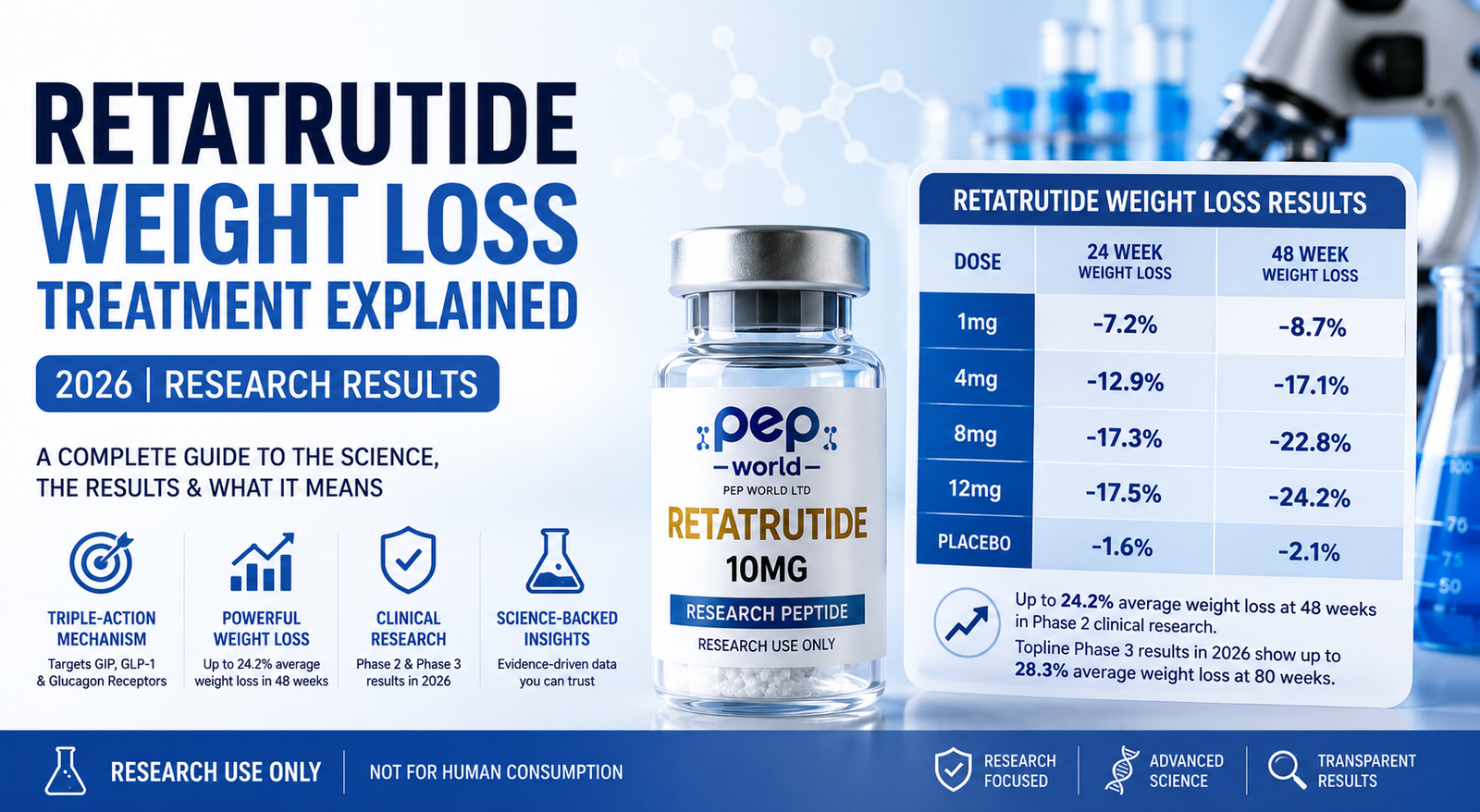
In the 2023 Phase 2 trial published in the New England Journal of Medicine, 338 adults with obesity or overweight plus a weight-related condition were studied for up to 48 weeks.
At 48 weeks, the reported average percentage changes in body weight were:
| Retatrutide Group | 24-Week Weight Change | 48-Week Weight Change |
|---|---|---|
| 1 mg | −7.2% | −8.7% |
| 4 mg | −12.9% | −17.1% |
| 8 mg | −17.3% | −22.8% |
| 12 mg | −17.5% | −24.2% |
| Placebo | −1.6% | −2.1% |
These are the least-squares mean changes reported in the trial, not a guarantee of what an individual person would experience.
What does that mean in real numbers?
For example, a 100 kg research participant experiencing a 24.2% reduction would correspond to approximately 24.2 kg of body weight. That would put the participant at roughly 75.8 kg. But this is only a mathematical illustration of the reported percentage not a prediction for an individual.
Retatrutide Weight Loss at 48 Weeks
The 48-week results from the Phase 2 study are particularly interesting because weight loss continued throughout the study period. At the highest studied dose in that trial, the reported average reduction reached 24.2% at 48 weeks. The researchers also noted that the weight-loss curve had not clearly reached a plateau when treatment ended.
The study also found that:
- 92% of participants receiving 4 mg achieved at least 5% weight loss.
- 75% achieved at least 10% weight loss.
- 60% achieved at least 15% weight loss.
- At 8 mg, 100% achieved at least 5% weight loss.
- At 12 mg, 100% achieved at least 5% weight loss and 83% achieved at least 15% weight loss.
These numbers explain why retatrutide attracted so much attention after the Phase 2 results.
Updated Retatrutide Results in 2026
There is now more research available than when the original Phase 2 results were published. In May 2026, Eli Lilly reported topline Phase 3 results from TRIUMPH-1. According to the company’s announcement, participants receiving 12 mg retatrutide lost an average of 28.3% of body weight over 80 weeks, equivalent to an average of 70.3 lb, while 45.3% achieved at least 30% weight loss. The 4 mg group had an average weight reduction of 19.0% at 80 weeks. This is important because it shows that the larger weight reductions seen in earlier research were not necessarily limited to the 48-week Phase 2 timeframe.
However, these 2026 Phase 3 figures were announced as topline results, and detailed findings should be interpreted alongside the eventual peer-reviewed publication.
Retatrutide Weight Loss Results: Phase 2 vs 2026 Phase 3
| Study | Dose | Time | Reported Average Weight Loss |
|---|---|---|---|
| Phase 2 | 1 mg | 48 weeks | 8.7% |
| Phase 2 | 4 mg | 48 weeks | 17.1% |
| Phase 2 | 8 mg | 48 weeks | 22.8% |
| Phase 2 | 12 mg | 48 weeks | 24.2% |
| TRIUMPH-1 Phase 3 | 4 mg | 80 weeks | 19.0% |
| TRIUMPH-1 Phase 3 | 12 mg | 80 weeks | 28.3% |
The studies are not directly interchangeable because they have different designs, durations and populations. The table is best viewed as a research timeline, rather than a head-to-head comparison.
Why Are Researchers So Interested in Retatrutide?
The biggest reason is the magnitude of weight reduction observed in clinical research. The Phase 2 study found that some participants receiving higher doses achieved reductions of 20%, 25% or even 30% or more. In the 12 mg group, 26% of participants achieved at least a 30% reduction in body weight at 48 weeks. The 2026 TRIUMPH-1 results pushed those numbers further, with Lilly reporting that 45.3% of participants receiving 12 mg achieved at least 30% weight loss at 80 weeks. That level of weight reduction is one reason retatrutide has become such an important subject in current obesity research.
What About Side Effects?
Large weight-loss numbers should not be viewed in isolation. In the Phase 2 trial, the most common adverse events were gastrointestinal, and they were generally mild to moderate. Researchers also observed that these effects were dose-related. Starting with a lower dose appeared to reduce some of these problems. The study also reported dose-dependent increases in heart rate, which peaked around 24 weeks and subsequently declined.
This is precisely why clinical trials matter. A compound cannot be evaluated purely by asking, “How much weight did people lose?” Researchers also need to establish its safety profile, appropriate dosing, long-term effects and risk-benefit balance.
Is Retatrutide Approved for Weight Loss?
No. Retatrutide remains investigational.
This distinction is extremely important for anyone researching peptides online. Lilly states that retatrutide has not been approved by any regulatory agency and warns against taking products claiming to contain retatrutide outside Lilly-sponsored clinical trials. So although the research results are promising, it would be misleading to market retatrutide as an approved weight-loss medicine.
Retatrutide vs Other Weight-Loss Peptides
Retatrutide is often discussed alongside semaglutide and tirzepatide because all three are part of the rapidly developing metabolic research landscape. The major distinction is their receptor activity.
| Compound | Main Receptor Activity | Research Interest |
|---|---|---|
| Semaglutide | GLP-1 | Appetite, glucose regulation and weight management |
| Tirzepatide | GIP + GLP-1 | Weight and metabolic outcomes |
| Retatrutide | GIP + GLP-1 + Glucagon | Multi-pathway metabolic and weight-loss research |
What the Research Actually Tells Us
The biggest takeaway is straightforward:
Retatrutide has produced substantial weight reductions in clinical trials, and the magnitude of weight loss has increased with longer treatment and higher studied doses. But there is an equally important second takeaway:
Promising research results do not automatically make an investigational compound an approved treatment. The 2023 Phase 2 data demonstrated average weight reductions reaching 24.2% at 48 weeks with the 12 mg group. More recent 2026 Phase 3 topline data from TRIUMPH-1 reported an average 28.3% reduction at 80 weeks with 12 mg. Those numbers are impressive but they belong in the context of controlled clinical research rather than being treated as guaranteed outcomes.
Frequently Asked Questions
In the Phase 2 trial, the 12 mg group had an average 24.2% reduction in body weight at 48 weeks. Lilly's 2026 TRIUMPH-1 topline results reported an average 28.3% reduction at 80 weeks with 12 mg.
Retatrutide activates the GIP, GLP-1 and glucagon receptors, giving it a triple-agonist mechanism.
No. It remains an investigational compound and is not an approved weight-loss treatment.
Gastrointestinal adverse events were among the most common in the Phase 2 trial, with frequency generally increasing at higher doses.
No. Semaglutide primarily acts through the GLP-1 receptor, whereas retatrutide is designed to activate GIP, GLP-1 and glucagon receptors.
Final Thoughts
Retatrutide is one of the most interesting compounds currently being studied in obesity research.
The numbers are difficult to ignore: 24.2% average weight reduction at 48 weeks in the Phase 2 study, followed by 28.3% at 80 weeks in the 2026 TRIUMPH-1 topline results for the 12 mg group. But the responsible conclusion isn’t that retatrutide is a miracle treatment. The better conclusion is that the clinical evidence is producing unusually strong weight-loss signals, while researchers continue to evaluate safety, long-term outcomes and regulatory approval.
For anyone following peptide and metabolic research, retatrutide is certainly a compound worth watching but it should be discussed through the lens of clinical evidence rather than hype.