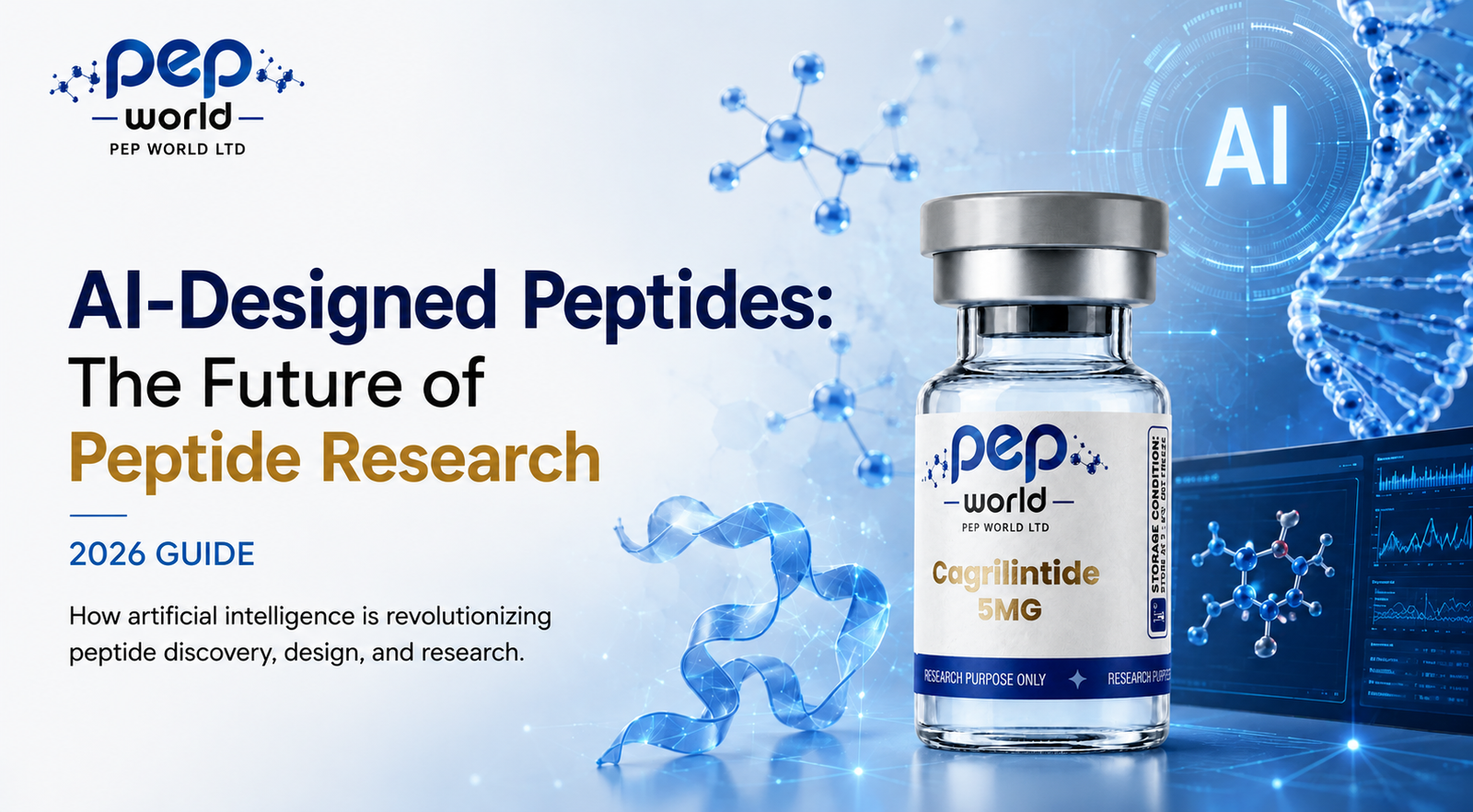
Peptide research is no longer just about trial and error.
In 2026, scientists are increasingly turning to artificial intelligence to design peptides faster, more accurately, and with far better precision than traditional methods. What used to take months of lab work can now be predicted in hours using advanced algorithms.
This shift isn’t hype it’s changing how peptide research is done at a fundamental level.
What Are AI-Designed Peptides?
AI-designed peptides are peptide sequences created or optimized using machine learning models instead of relying solely on traditional laboratory experimentation.
These systems analyze massive datasets of:
- Amino acid sequences
- Protein structures
- Biological interactions
Based on this data, AI can predict which peptide structures are most likely to behave in specific ways during research.
In simple terms:
Instead of guessing and testing, researchers now predict first, test later.
Why AI Is Becoming Essential in Peptide Research
Traditional peptide development has always had a major limitation time.
Researchers often had to:
- Design multiple variations
- Test each one in the lab
- Analyze results
- Repeat the process
This cycle is slow and expensive.
AI changes that by:
- Reducing trial-and-error
- Identifying promising candidates early
- Optimizing peptide sequences before synthesis
The result?
Faster research with better outcomes.
How AI Designs Peptides
AI doesn’t just “create” peptides randomly. It follows structured processes:
1. Data Training
AI models are trained on existing peptide and protein databases, learning patterns in:
- Structure
- Function
- Binding behavior
2. Sequence Prediction
The system generates new peptide sequences based on learned patterns.
3. Simulation
Before anything is synthesized, AI simulates how the peptide might behave in different environments.
4. Optimization
Weak candidates are filtered out, and stronger ones are refined further.
Only the most promising peptides move forward into actual laboratory testing.
Key Benefits of AI in Peptide Research
Faster Discovery
What used to take months can now happen in days.
Higher Accuracy
AI reduces the number of failed experiments by predicting outcomes more reliably.
Cost Efficiency
Less lab testing means lower research costs.
New Possibilities
AI can discover peptide structures that humans might never consider.
Real-World Applications in Research
AI-designed peptides are being explored in several research areas:
- Cellular signaling studies
- Protein interaction models
- Enzyme behavior research
- Regenerative biology experiments
Instead of focusing on known peptides only, researchers can now explore entirely new molecular possibilities.
Challenges and Limitations
- Let’s be clear AI isn’t perfect.
- Data Dependency
- AI is only as good as the data it’s trained on.
- Prediction vs Reality
- Even the best models can’t fully replace real-world lab validation.
- Complexity of Biology
- Biological systems are unpredictable, and not everything can be simulated accurately.
- So while AI speeds things up, lab testing is still essential.
The Future of AI in Peptide Research
The next phase of peptide research will likely combine:
- AI-driven design
- Automated lab testing
- Real-time data feedback
This creates a loop where:
AI designs → Lab tests → AI improves → Better peptides are created
Over time, this will lead to:
- More precise peptide development
- Faster innovation cycles
- Stronger research outcomes
What This Means for the Industry
For researchers and suppliers, the shift toward AI means:
- Greater demand for high quality, verified peptides
- Increased focus on purity and reproducibility
- More advanced research requirements
Low quality or inconsistent peptides will quickly become irrelevant in this environment.
Final Thoughts
AI-designed peptides are not just a trend they represent a fundamental shift in how research is conducted.
Instead of relying on slow, repetitive testing, researchers now have the ability to predict, refine, and optimize peptides before they even reach the lab.
And in a field where precision matters, that changes everything.
Disclaimer
All peptides mentioned are intended for research purposes only. They are not approved for human consumption or medical use.